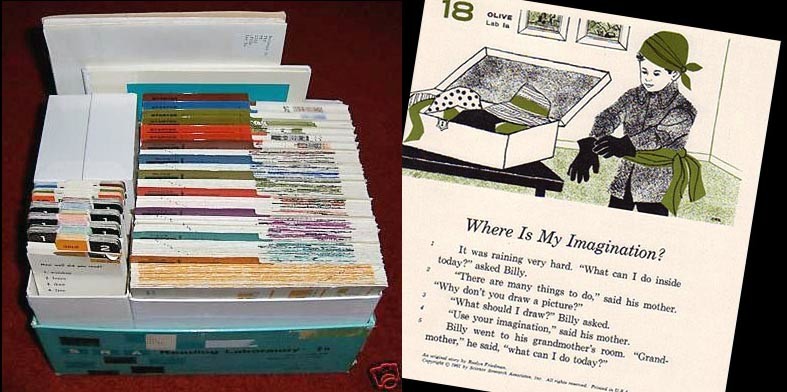
In my 4th grade we had an SRA box on the table by the classroom door. It contained colored tabs signifying different reading levels. The tabbed sections contained large cards with stories printed on them. The idea was to start at your level and work your way to a higher level. I loved that box. It gave me freedom to explore at my own pace. While this was intended for linear use, start on one level and progress to more difficult levels, I created a different experience. Some days I enjoyed a challenge and chose a difficult reading level. Other days I just needed to get through a card and chose an easy one. And at other times, I compared the stories on the different levels. I loved this box because it was nothing like the linear and highly level-dependent learning of my other subjects. I have never forgotten that box and the experience it allowed. It was pure joy to me.
In traditional education, we’ve long compartmentalized learners into rigid categories: remedial, beginner, intermediate, advanced. While this model has served its purpose, it’s time to ask ourselves: Are we inadvertently creating barriers to learning? Are we stealing the joy of learning by creating learning experiences that resemble cattle chutes – narrow, rigid pathways that force movement in only one direction – rather than embracing the brain’s natural capacity for creative, multi-directional learning?
At YU Global, we’re pioneering a different approach. Instead of deciding for our learners how much they should learn and when, we’re building flexible pathways that empower individuals to chart their own educational journey. Think of it as a learning ecosystem rather than a fixed ladder.
This new model recognizes a fundamental truth: learning isn’t linear. A professional might be advanced in one aspect of software development but completely new to another. A business owner might need deep knowledge in one area but only foundational understanding in others. Why should we force these diverse needs into predetermined boxes?
Our approach allows learners to dive as deeply as they need to at any given moment. Someone might start with basic concepts, discover a particular interest, and delve deeper into that specific area while maintaining a broader overview of other topics. Another person might need advanced knowledge immediately in one module while gradually building foundational skills in others.
The benefits of this flexible approach are significant:
First, it respects the reality of how people actually learn and work in today’s world. Knowledge needs aren’t uniform – they’re dynamic and context-dependent.
Second, it eliminates the stigma often associated with being a “beginner” or feeling “behind.” When everyone can customize their learning path, these labels become meaningless.
Third, it creates more efficient learning experiences. Learners spend time on what they truly need rather than following a predetermined path that might not serve their specific goals.
Finally, and perhaps most importantly, it keeps doors open. Instead of making decisions that limit future options, learners can continuously adjust their path as their needs and interests evolve.
This is more than just a different way of organizing content – it’s a fundamental shift in how we think about learning. It’s about creating an educational environment that truly serves the diverse needs of our community, recognizing that knowledge acquisition isn’t a one-size-fits-all journey.
As we continue to develop this model at YU Global, we’re seeing how it creates more engaged, confident learners who take ownership of their educational journey. In today’s rapidly evolving world, this kind of adaptable, learner-centered approach isn’t just nice to have – it’s essential for preparing people for the challenges and opportunities ahead.
The future of education isn’t about sorting learners into levels – it’s about giving them the tools and freedom to define their own path to success.
At YU Global, we’re asking a different question. Not “What level are you?” but “Where do you want to go?” By removing artificial barriers and putting learners in control of their educational journey, we’re doing more than changing how people learn – we’re transforming what they believe is possible. Join us in reimagining education, one empowered learner at a time.
 daniellewozniak