I love watching episodes of Ted Lasso. When Coach Beard uttered these words to a colleague, using metaphor to stress the importance of cooperation, it resonated.
Coach Beard: You know, we used to believe that trees competed with each other for light. Suzanne Simard’s field work challenged that perception, and we now realize that the forest is a socialist community. Trees work in harmony to share the sunlight.
Nathan: Can’t you just give me a straight answer for once?
Roy: I think he just did.
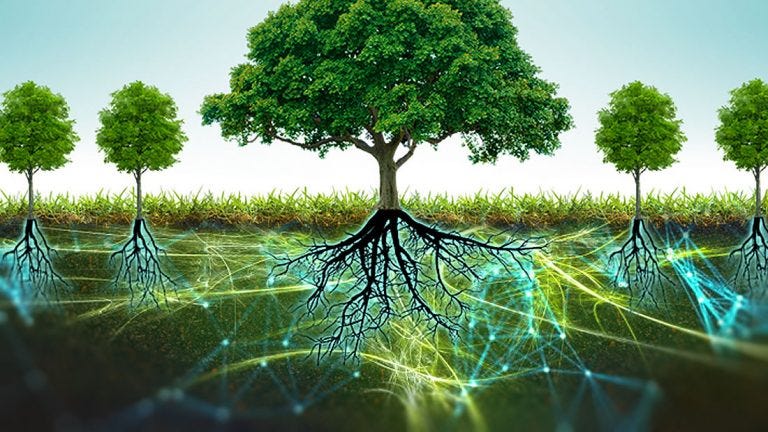
Coach Beard was referring to Dr. Suzanne Simard, a professor of forest ecology at the University of British Columbia, has spent decades uncovering what she calls the “wood-wide web” — an underground network of fungal connections that allows trees to communicate, share resources, and support one another. Her groundbreaking research has revealed that forests aren’t merely collections of individual trees competing for sunlight and nutrients, but interconnected communities where cooperation and mutual aid are essential survival strategies.
This research offers a powerful metaphor for reimagining how institutions of higher education might work together in an increasingly challenging landscape.
From Competition to Cooperation
For too long, we have operated under a model that resembles the old, limited understanding of forests: as battlegrounds where individual institutions compete fiercely for students, faculty, resources, and prestige. This competition-based model has led to duplicated efforts and escalating marketing costs. But what if, like Simard’s trees, we recognized that our institutions could thrive not despite but because of our connections to one another?
The Underground Network: Shared Technology Infrastructure
In Simard’s forests, the most surprising discovery was the role of mycorrhizal fungi — the underground network that connects tree roots and facilitates the exchange of carbon, nitrogen, and other vital nutrients. Trees that might appear to be competitors on the surface are actually supporting each other below ground.
At YU Global, we’ve invested in developing technological infrastructure that mirrors this fungal network. Our rapid digital course generation capacity, learning management systems, student support platforms, and data analytics tools aren’t designed to serve just our institution alone. We’ve built them with the capacity to be shared across multiple educational partners, creating economies of scale that benefit everyone connected to the network.
Just as a mature Douglas fir might send carbon to younger seedlings through fungal connections[1], our established technology systems can support smaller or growing institutions without diminishing our own capabilities. In fact, this sharing strengthens the entire educational ecosystem.
We’re not alone in this approach. SUNY Online and Georgia’s eCampus offer shared platforms and support services across dozens of state campuses — reducing duplicative spending and allowing smaller institutions to scale their online programs efficiently. These public systems demonstrate how technology sharing can be a strategic asset rather than a competitive liability.
Resource Sharing: The Marketing Consortium
Another aspect of forest ecology is how trees redirect resources to neighbors in need. When one tree has abundance, the network ensures those resources flow to where they’re most needed. We are piloting a marketing consortium that operates on a similar principle.
Marketing and student recruitment represent significant expenses for most institutions, with many schools independently creating similar campaigns and competing for the same online advertising space — driving up costs for everyone.
In combination with digital course development, we’ve designed a shared marketing model to address these challenges, reducing costs and improving recruitment outcomes across partner institutions. While course-sharing consortia like Acadeum are increasingly common, shared marketing infrastructure among institutions remains rare. Unlike for-profit providers such as Risepoint or ScholarBuys—which offer external marketing or procurement services—our model is rooted in inter-institutional collaboration. It is not a vendor-client relationship, but rather a peer-based consortium where institutions jointly plan, execute, and benefit from shared strategies. This cooperative structure prioritizes mission alignment, transparency, and sustainability over commercial service delivery.
Through our marketing consortium, partner institutions pool resources, share expertise, and coordinate efforts. This collaboration doesn’t mean losing institutional identity; rather, it allows each school to maintain its unique brand while benefiting from shared costs, collective bargaining power with advertising platforms, and the exchange of successful strategies.
While the centralized marketing approaches of systems like SUNY Online and Georgia’s eCampus have proven effective at lowering acquisition costs, their reach is geographically limited to in-state collaboration. YU Global provides an agile, scalable alternative that’s not confined by geography, governance, or state funding models. We’re launching this consortium with select partners now.
Mutual Support in Changing Conditions
Simard’s research revealed something particularly remarkable about forest communities: they’re most cooperative during times of stress. When drought, disease, or other challenges arise, the sharing network becomes even more active, helping the forest as a whole weather difficult conditions.
Higher education today faces unprecedented challenges: demographic shifts, funding pressures, technological disruption, and changing student expectations. Rather than retreating into competitive isolation during these stressful times, we have an opportunity to strengthen our connections.
By working together — sharing technological infrastructure, marketing resources, and best practices — we can collectively adapt to these changing conditions more effectively than any single institution could alone.
Fulfilling Our Mission Together
The most profound lesson from forest ecology may be that cooperation doesn’t require sacrificing individual identity or success. Each tree in the forest remains distinct, with its own structure and relationship to the environment. Yet through cooperation, the forest as a whole becomes more resilient, more productive, and better able to sustain all its members.
Similarly, educational cooperation doesn’t mean homogenization. Each institution maintains its unique mission, culture, and strengths. But through strategic collaboration, we can all become more effective at what matters most: providing accessible, high-quality education to our students.
At YU Global, we believe this forest model of education — where institutions support rather than merely compete with one another — represents the future of higher education. By reducing duplicated efforts in technology and marketing, we can redirect resources toward our core educational mission. We can invest more in faculty, in learning experiences, in student support, and in keeping education affordable.
Just as Simard’s research transformed our understanding of forests from collections of competitors to competitors and also cooperative communities, we can transform higher education from a zero-sum competition to a thriving ecosystem where cooperation helps all institutions better fulfill their educational mission.
We invite other institutions to join us in this vision. Like trees in a healthy forest, we can grow taller together than any of us could alone.
Dr. Danielle Wozniak, MSW, PhD is the Vice President for Global Strategy and Head of YU Global at Yeshiva University, where they lead initiatives focused on inter-institutional cooperation and resource sharing in higher education. https://www.linkedin.com/in/daniellewozniak/
[1]: While Simard’s research documents carbon transfer between mature trees and seedlings, particularly among Douglas firs, many ecologists note that the scale of this sharing is modest and context-dependent. The metaphor here reflects the structural possibility of support, not an exact equivalence to parental nourishment. See: Simard et al., 1997; Karst et al., 2023.
References
Karst, J., Jones, M. D., & Hoeksema, J. D. (2023). The decay of the wood-wide web? Nature Ecology & Evolution, 7, 1–3. https://doi.org/10.1038/s41559-022-01974-1
Simard, S. W., Perry, D. A., Jones, M. D., Myrold, D. D., Durall, D. M., & Molina, R. (1997). Net transfer of carbon between ectomycorrhizal tree species in the field. Nature, 388(6642), 579–582. https://doi.org/10.1038/41557
 daniellewozniak